Analemma Tower: A Sky-Suspended Skyscraper Concept
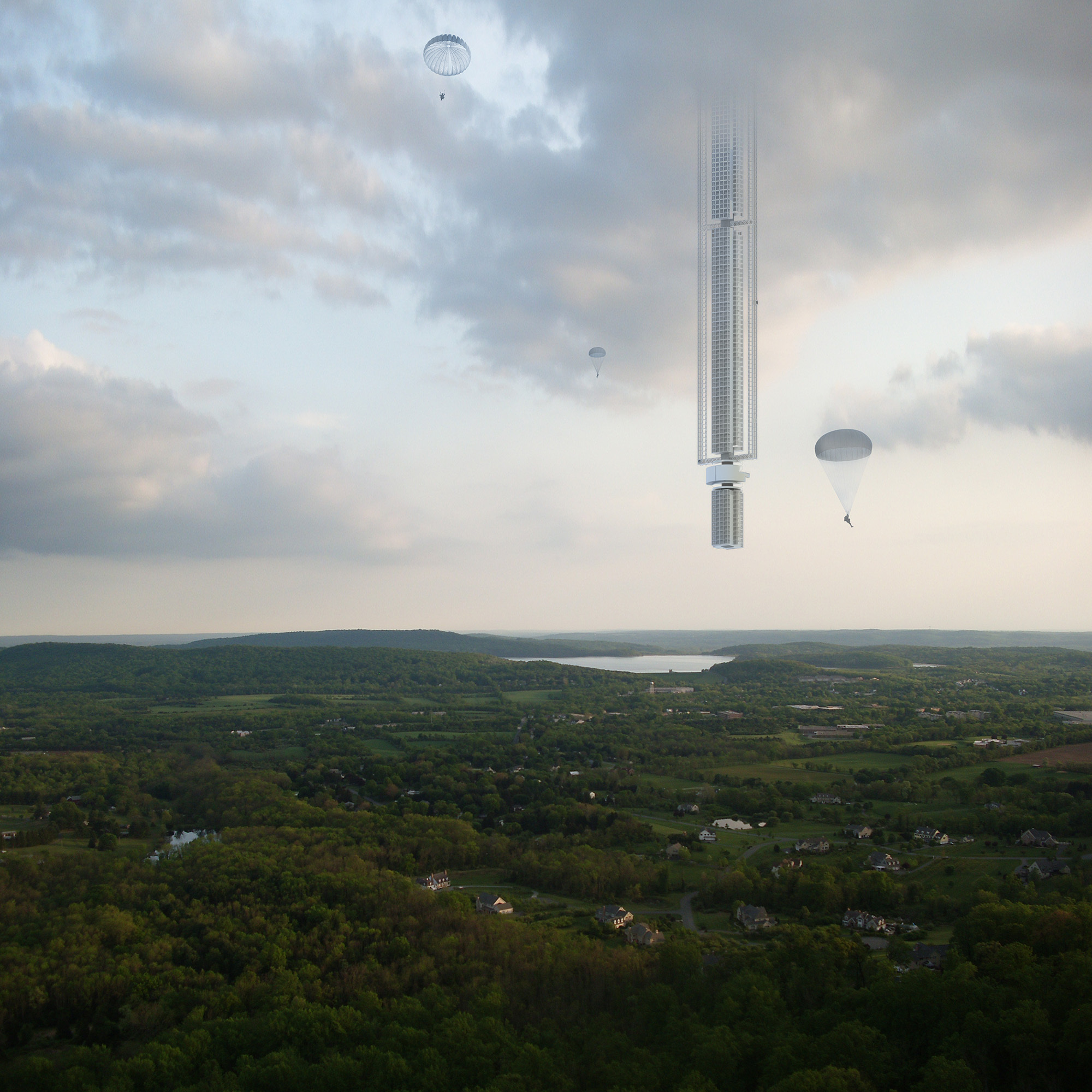
Image credit: Clouds Architecture Office
The Analemma Tower is a speculative design by New York's Clouds Architecture Office (partners Masayuki Sono and Ostap Rudakevych) first unveiled in 2017. It envisions the world's tallest building hanging from space rather than rooted in the ground. In the proposal, a large asteroid would be placed in geosynchronous orbit above Earth, roughly 31,000–50,000 km high. From this "anchor" an ultratall skyscraper would be lowered on high-strength cables, so that the tower hangs upside-down in the sky.
The architects describe it as a "Universal Orbital Support System" – essentially a space-based foundation rather than a terrestrial one. Because the asteroid would orbit once per day, the tower would trace a figure-eight ground track, drifting between northern and southern latitudes each day. According to Clouds AO, this path could even be timed so the slowest part of the orbit lies over a major city (they calibrate it over New York), offering residents breathtaking, ever-changing views. The designers propose building the structure on the ground first (in Dubai, for cost efficiency) and then hoisting it into place under the asteroid.
Design Features and Vision
Key features of the Analemma Tower design include space-based power and environmental control. The plan calls for solar panels mounted above the atmosphere (where they have continuous sunlight) to power the building. Water and air would be recycled in closed-loop systems, filtering rain and cloud condensate for use. Advanced magnetic elevators (free of cable spool limits) are envisioned to move people through its 28–32 kilometer height.
Floors would be zoned by use: Clouds AO suggests commercial and public spaces at the bottom, residences mid-level, and even sacred or "devotional" spaces near the top. (Higher floors would enjoy 40 minutes more daylight and extreme conditions like –40°C and near-vacuum air pressure.) The architects argue that by moving all this infrastructure into the sky, the Earth's surface could be freed for nature – "our planet [could] heal itself" once concrete megastructures are off-world.
Media Coverage and Updates (2020–2025)
Since its introduction, Analemma Tower has mostly appeared in design and tech media as a visionary concept. In May 2022 Architectural Digest ran a feature on Clouds AO's sky-high vision. The AD article quoted the architects on the historical trend toward ever-taller buildings and their belief that "by leaving the surface we can allow our planet to heal itself". It framed the tower as part of a broader "floating city" idea, imagining the Earth returned to nature below a suspended metropolis.
More recently, mainstream outlets have again highlighted the Analemma Tower idea. In May 2025 NDTV published a report noting that the Analemma Tower "would hang from an asteroid in space" on a geosynchronous orbit. NDTV quoted Clouds AO's description of the project: placing an asteroid in orbit and lowering a "super tall" tower from it by cable. The report emphasized that the designers plan to build the tower over Dubai (for cost reasons, as Dubai is experienced with megatowers) and cited the firm's claim that such a tower could be constructed "anywhere in the world" once suspended in air.
An accompanying Robb Report feature (2025) further detailed the concept's parameters: it stated the asteroid would orbit at ~50,000 km altitude, with the tower hanging between about 3.4 km and 32 km above Earth (making it ~28.6 km tall). Robb Report also noted the architects' plan for bottom floors to host business and entertainment, mid-levels for living, and top floors for religious use. All these accounts stress that Analemma remains theoretical – a thought experiment exploring future possibilities rather than a concrete construction project.
Feasibility and Expert Commentary
Analemma Tower's feasibility has been widely questioned by engineers and space scientists. Experts point out that the proposal relies on technologies and materials that do not yet exist. For example, an analysis on ArchDaily calls the design "utopian" and notes multiple major obstacles. One critical issue is material strength: to span ~36,000 km (the combined length of the cable), we would need a tether far stronger than anything known. As ArchDaily explains, today's strongest cables (carbon nanotubes) would snap under their own weight long before reaching those lengths.
On the space technology side, NASA has studied related concepts but has no active mission to place a large asteroid into Earth orbit. The agency's proposed Asteroid Redirect Mission (ARM), mentioned by Clouds AO as a precedent, was cancelled in 2017. That mission had aimed to test moving a chunk of asteroid material into lunar orbit, but NASA's official statements confirm it was ended by a 2017 policy directive. More recently, NASA's OSIRIS-REx spacecraft did retrieve a sample from near-Earth asteroid Bennu and returned it in 2023, but that was a small-scale scientific mission, not an attempt to relocate the asteroid itself.
Urban planners and infrastructure experts have also treated the idea as a conceptual vision. The design team itself refers to Analemma as "theoretical". While the floating-skyscraper concept challenges conventional thinking (and some cite potential long-term economic gains in sky-high real estate), it remains a futuristic proposal. No feasibility study, engineering design, or funding plan for the tower has been released.
Current Status and Outlook
As of 2025, the Analemma Tower exists only in digital renderings and media coverage. Clouds Architecture Office has not announced any progression beyond the concept stage. The firm's published materials and public statements continue to emphasize the tower's role in "exploring possibilities" for a future of architecture. Industry experts continue to point out the immense challenges (from materials to orbital mechanics) that would have to be solved. In practical terms, the Analemma Tower serves as a provocative vision of a future space-elevated city, rather than a concrete project underway. Any realization of this idea would require breakthroughs in space technology, materials science, and international coordination far beyond current plans.